After the movieThe Cost of Growth brings together a lot of stories, research, lived realities, and for many people it can feel like an overwhelming amount of new information. That’s okay. This documentary is meant to open up questions, not to leave you alone with them.
We’re currently working on gathering and bundling the sources, people, and stories that appear in the film, so you can dive deeper at your own pace. At the same time, we’re developing new projects and collective pathways that build on the film; ways to get involved, connect with others, and turn reflection into action. This is not the end of the conversation, but an invitation to continue it together.
We want to know how the film moved you!
Help us understand the way our documentary resonates with you, and take 5 minutes to fill in our short survey! Thanks so much!
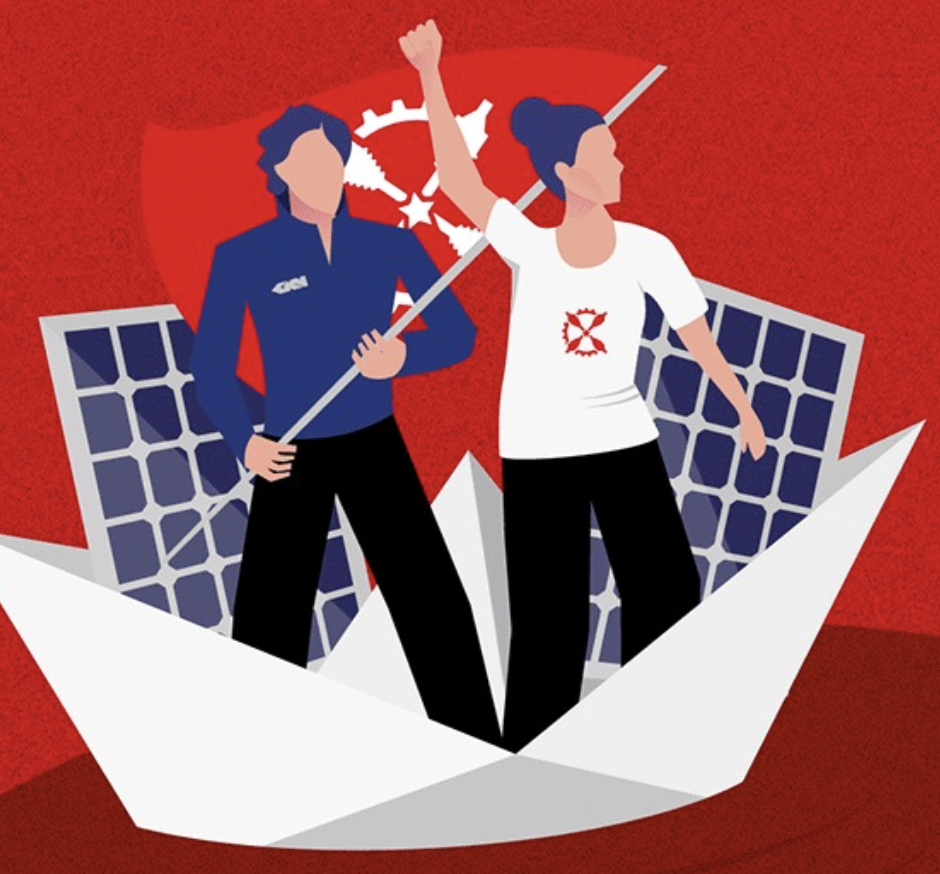
You can support GKN right now, at a historic turning point in a struggle that goes far beyond one factory.
Since 2021, workers at the former GKN plant in Campi Bisenzio have occupied their workplace, refusing mass layoffs and corporate abandonment, and instead fighting to reclaim the factory as a worker-run cooperative producing socially and ecologically useful goods.
What began as resistance has become one of the most radical experiments in democratic, climate-just reindustrialisation in Europe. Today, as institutions stall, capital blocks, and repression looms, the workers are ready to move from occupation to reconstruction.
Supporting GKN now means taking sides in an unprecedented struggle to reclaim the future of work, industry, and the climate. What the workers are building in Campi Bisenzio has no blueprint handed down from above: it is a living, collective experiment in breaking with exploitation, greenwashing, and corporate blackmail.
Global military spending
Capital accumulation in wealthy “core” countries depends on exploiting cheap labor, resources, and markets in the global South. To preserve this system, core states—led by the United States—work to block peripheral countries from achieving economic sovereignty or independent industrial development, which could raise costs or threaten core monopolies.
To enforce this order, the imperial core has built an extensive military apparatus used to intervene across the global South through invasions, occupations, regime change (including against elected governments), and repression of socialist or liberation movements, often with the backing of local elites.
The United States dominates this system: despite having only 4% of the world’s population, it accounts for over half of global military spending. Together with NATO and key allies, the imperial core controls about 75% of world military expenditure, compared to roughly 3% for Russia and 10% for China.
Global use of materials exceeds safe limits
Global material resource use—including metals, minerals, construction materials, fossil fuels, and biomass—has steadily increased over the past century. Scientists warn that annual use should stay below 50 billion tons to avoid severe ecological damage. This threshold was surpassed in the late 1990s, and consumption has continued to rise, driving over 90% of biodiversity loss and other ecosystem harms.
Responsibility for ecological breakdown
This graph illustrates how responsibility for cumulative excess resource use has shifted over time. While countries in the global North continue to be the primary contributors, China’s share has grown significantly since the early 2000s, largely driven by rapid infrastructure expansion.
Unequal exchange
Economic growth in rich countries depends on taking a large amount of resources and labour from poorer countries. This happens through unequal trade between the global North and the global South. Scholars such as Samir Amin, Ruy Mauro Marini, and Arghiri Emmanuel have long described this pattern.
Unequal exchange exists because powerful Northern governments and corporations use their political and economic power to keep wages, prices, and profits low in the global South. This happens both within Southern economies and across global supply chains. As a result, goods produced in the South are sold for much lower prices than goods from the North.
These price gaps are far bigger than differences in productivity. Because of this, Southern countries must export much larger quantities of goods just to afford the same amount of imports from the North. The graph shows how this imbalance forces the South to give more and get less.
Source
Global Atlas of Environmental Justice
The Global Atlas of Environmental Justice is a shared map of environmental harm and resistance around the world. It brings together stories of communities who are pushed to bear the costs of mining, oil extraction, dams, land grabs, waste dumping, and other destructive projects—and who fight back. Built with activists and researchers, it shows who is affected, who benefits, and what people are doing to defend their land, health, and livelihoods. More than a database, it’s a way to make these struggles visible and to show that environmental damage is deeply tied to power, inequality, and injustice.